

A milking robot costs between €110,000 and €160,000 for a new milking stall, and the total cost often exceeds €180,000 once it’s installed: the milking robot is one of the biggest investments for a dairy farm dairy. The purchase price isn’t the only cost to consider. In this article, we’ll discuss this and break down the differences between buying a new machine and a used one to help you make your decision.
At Backfarmer, we buy, inspect, and resell used milking robots throughout Europe, drawing on 15 years of experience in livestock equipment. Here’s what a milking robot really costs, whether new or used.
In a nutshell: the price of a milking robot
€110,000 to €160,000
New robot
€25,000 to €85,000
Recent Used Robot
€4,000 to €10,000 per year
Maintenance by stall
How much does a new milking robot cost?
A new milking robot generally costs between €110,000 and €160,000 per milking stall, and around €180,000 once all the installations are complete, based on the prices we’ve observed on Backfarmer. The exact price depends on the brand, the options, and the configuration of your farm.
Price by Brand
Manufacturers do not publish price lists: each new robot is sold based on a quote, depending on the selected options and the dealership. The differences between brands are driven more by the options, the service network, and resale value than by the robot’s base price.
Brand
Recent Models
New Product Positioning
Used
A5, A5 Next
One of the most expensive, the most widespread brand in Europe
Retains a high resale value
V300, V310
High-end, comprehensive DelPro software, options such as RePro on the V310
A more significant discount; excellent value for the price
R9500
Competitive, especially for systems with 2 to 4 robots
Significant discounts, real opportunities
Gemini Up
One installation for two stalls
Less common in Europe; check with your local customer service department
One stall, two stalls, or multiple robots
The cost does not double with the number of stalls. A dual-stall robot, such as the BouMatic Gemini Up, shares some of the equipment: it is often the most cost-effective solution for milking 120 to 140 cows.
The price per cow
A milking parlor milks an average of 70 to 80 cows. A robot costing €180,000 therefore works out to about €2,200 to €2,600 per cow. This calculation shows one thing above all: a robot that isn’t fully utilized results in poor profitability.
Used Milking Robots: How Much Do They Cost and Why Are They Cost-Effective?
A recent used milking robot costs €85,000—half the price of a new one—and features very similar technology. The robots released since 2019 by Lely, DeLaval, and GEA are reliable and are based on a design that is still widely used in current new models.
The price of a used robot depends on the brand and age
When it comes to used items, not all brands are created equal at the same price. Here’s what we see every day at Backfarmer:
Lely retains strong resale value. An Astronaut A5 gives buyers peace of mind, but comes at a higher price: be sure to carefully compare the price with the year of manufacture, the number of milkings, and the included equipment. DeLaval depreciates more. A well-maintained V300 from 2020 to 2022 offers one of the best value-for-money options on the market. GEA is often undervalued because it lacks a network as extensive as Lely’s or DeLaval’s in certain regions. That’s where you can find newer machines at significantly lower prices.BouMatic appeals to large herds with its double milking stall, provided there’s a brand-certified technician nearby.
How to Choose the Right Used Robot
Here's what you should check before buying:
- Maintenance history and the number of milkings performed
- The status of the arm, the camera, and the sensors
- Vacuum pumps, valves, computer systems, and peripheral equipment
- The conditions under which the robot operated, and whether it was idle for a long time: seals and valves can become damaged
- The direction of the robot—right or left—depending on the traffic flow in your building
- A technician trained by the manufacturer in your area
- Parts availability and the ability to update the software
At Backfarmer, we guarantee that your robot will work properly when you first turn it on. If a part fails a few weeks after you start using it, just give us a call, and we’ll send you the same used part for free.
The Backfarmer Method in 4 Steps
At Backfarmer, we are not a classifieds site: we purchase the robots we sell ourselves, and we are responsible for them until they arrive at your doorstep.
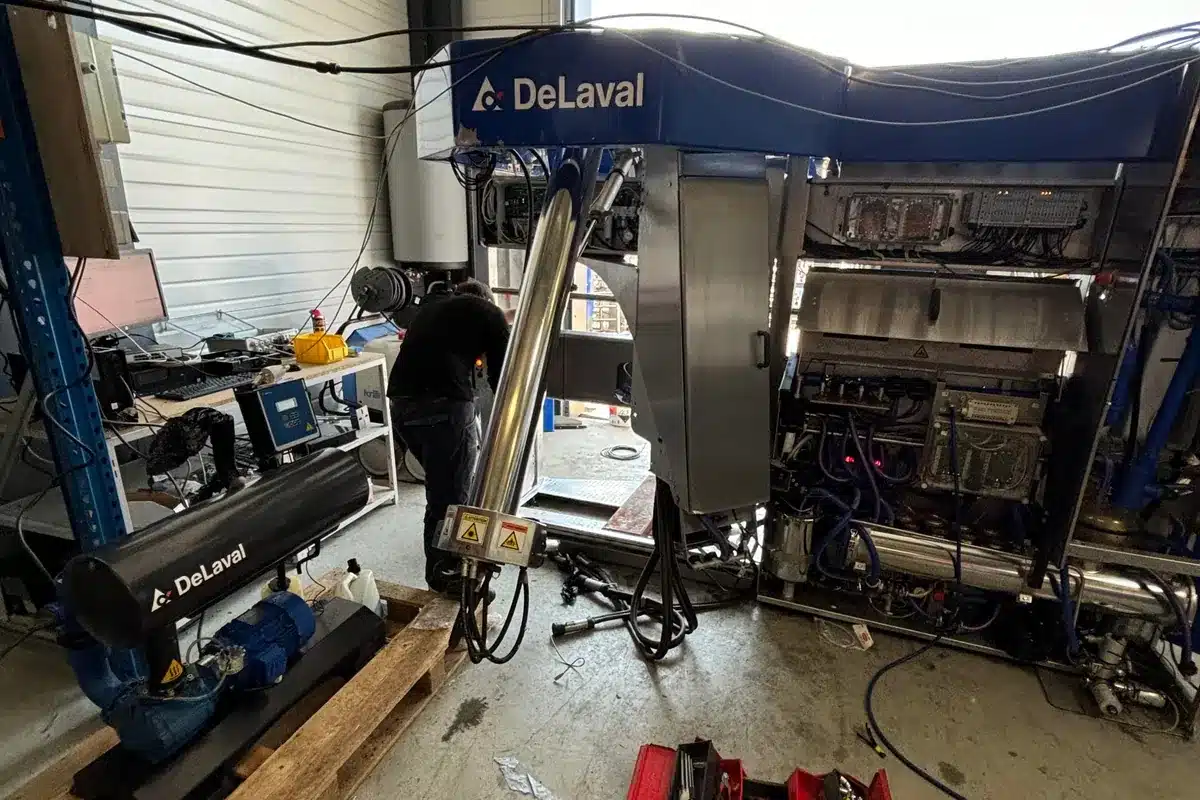
1. On-site inspection
History, number of passes, arm status, vacuum pump, computer system: we see the robot operating under real-world conditions.

2. Careful disassembly
Our team disassembles the robot and its equipment, labels the parts, and creates an inventory to facilitate reinstallation.

3. Robot-specific packaging
The arm, camera, sensors, and electronics are protected against impacts and moisture.
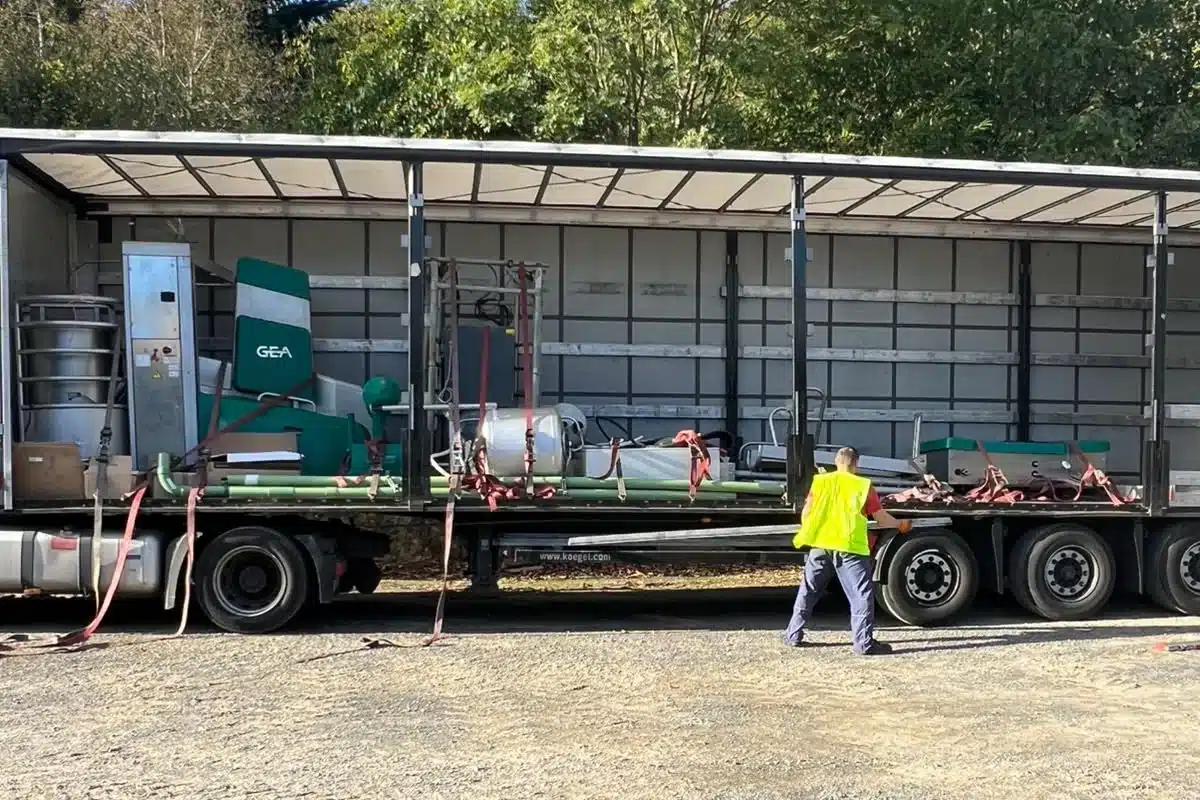
4. Shipping and Delivery
In France and in more than 30 countries, we’ll work with you every step of the way, right up to your farmyard.
Lely, DeLaval, GEA, BouMatic: Check out the used milking robots currently available.
View our used milking robotsA more sustainable choice
Reduced cost
The latest technology at a price lower than that of a new unit.
Sustainability
Less new manufacturing, less waste: a second life for equipment that still works well.
Accessibility
Robotic milking within reach of small and medium-sized farms.
Giving a milking robot a second life means avoiding the production of a new machine and making the most of equipment that is still in good working order—often the result of an early replacement at another dairy farm. It’s also an investment that retains its value: a robot can be disassembled, transported, and reinstalled, and major brands remain in high demand and are easy to resell.
Comparison of Purchase Costs: New, Subsidized New, or Used
For this comparison, we are using the highest prices observed. This table does not take into account the risk that the subsidy may not be granted—and assumes the maximum subsidy amount (40%)—nor does it consider the fact that it is sometimes possible to receive subsidies for a used robot. We findthat buying used remains the more cost-effective option.
New robot
New robot with EU funding (40% PCAE)
Used Backfarmer robot
Purchase Price (Installed)
180 000 €
180 000 €
85 000 €
Investment Assistance
0 €
− 72 000 €
0 € (not eligible)
Still needs to be funded
180 000 €
108 000 €
85 000 €
Loan interest (4.5%, 10 years)
47 500 €
28 500 €
22 400 €
Purchase Cost Over 10 Years
227 500 €
136 500 €
107 400 €
Purchase cost per 1,000 liters
35 €
21 €
17 €
Subsidies and Financing for a Milking Robot
In France, the main form of assistance is the PCAE, the Plan for the Competitiveness and Adaptation of Agricultural Operations. Funded by the European Union, the national government, and the regions, it subsidizes a portion of the equipment and buildings used in livestock farming, including milking robots.
What you need to know before counting on it:
- The rate and the maximum amount vary by region, generally ranging from 20 to 40 percent of eligible expenses.
- The grant funds new equipment: a used robot is generally not eligible.
- Funding is limited, and the application process takes several months. Funding is never guaranteed at the time you sign the estimate.
- Other measures may be added, such as regional building subsidies: in the Inosys Grand-Est case study, a building subsidy program provided approximately €30,000.
Check with your local Chamber of Agriculture or your advisor to find out what programs are available in your region.
The price of the robot is only part of the investment
Between the robot quote and the first milking, you need to factor in peripheral equipment, the barn, and the startup period.
Essential Equipment for Your Robot
A robot alone cannot process milk. It requires a central processing unit, a vacuum pump, a compressor, a buffer tank, sorting gates, and a milk tank capable of receiving milk continuously. Depending on your current setup, some of this equipment may be reusable, while other parts may need to be replaced.
That’s why at Backfarmer, we offer the robot along with all its equipment—the central unit, vacuum pump, buffer tank, computer, management software, and accessories—as soon as possible. This helps you avoid any unpleasant surprises during startup. You can also supplement your setup with used equipment, such as a DeLaval DVP 800 NFO vacuum pump, an Atlas Copco compressor, or a milk tank.
Architecture and Civil Engineering
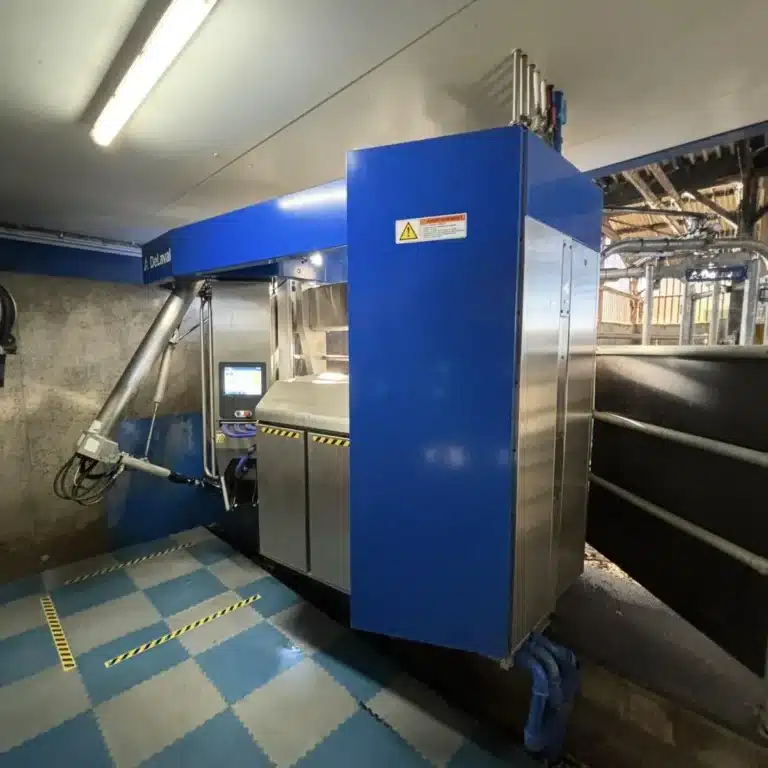
The robot is installed in a utility room, which includes a holding area, a separation stall, and a cow flow designed so that the cows come in on their own. If the barn needs to be expanded or reorganized, the cost can end up being much higher than the price of the robot itself.
How much does a milking robot cost per year?
Once installed, a robot costs around €11,000 per year to operate for a fully occupied stall—including maintenance, energy, and supplies. This is the expense that dairy farmers most often underestimate.
The Maintenance Contract
Based on our observations, maintenance costs between 5,000 and 10,000 € per year per stall, excluding hygiene products—that is, 8 to 15 € per 1,000 liters—compared to 7 € for a milking parlor. According to the German agricultural press, manufacturers’ maintenance contracts start at around €3,000 per year for Lely, €4,500 to €5,000 for DeLaval, and €3,500 to €4,000 for GEA.
Electricity, water, and products
Newer robots consume between 10 and 19 kWh per 1,000 liters. For a dairy farm that produces 650,000 liters per year, this amounts to approximately:
Model
kWh per 1,000 L
kWh per year
Annual cost: 0.20 €/kWh
GEA DairyRobot R9500
15
9 750
about 1,950 €
Lely Astronaut A5
16
10 400
about 2,080 €
DeLaval V300
17
11 050
about 2,210 €
You need to add about 1 m³ of water per stall per day, and about 4 to 5 € for every 1,000 liters of cleaning products and supplies, which comes to about 3,000 € per year.
Concentrates
A portion of the concentrates is distributed to attract the cows. The Inosys network reports an average additional feed cost of about €10 per 1,000 liters, or approximately €6,500 per year for a dairy operation producing 650,000 liters. The figures show that product distribution and costs vary significantly. You should therefore be careful when commissioning your machine and calibrate it properly during the first few months.
Breakdowns and Wear and Tear Over Time
Repair costs increase over time. In the United States, Hoard's Dairyman magazine estimates approximately $5,000 per year per robot in the early years, rising to around $10,000 for older robots. Above all, it is clear that maintenance and operating conditions matter far more than the robot's age.
"The year listed on the robot isn't everything. I'd much rather buy a 2020 robot that's been extremely well maintained than a 2023 robot that's been used in poor conditions and has an incomplete maintenance history."
Alexandre Duval, a backfarmer, in our 2026 comparison of used milking robots
Total operating cost over 10 years
Our assumptions: one barn, 75 cows, 650,000 liters per year. This table summarizes the operating costs detailed above: €6,000 for maintenance, €2,000 for electricity, and €3,000 for supplies per year, for a total of approximately €11,000 per year.
Over 10 years
Cost
Maintenance
60 000 €
Electricity
20 000 €
Products and Supplies
30 000 €
Total cost over 10 years
110 000 €
Over a ten-year period, operating a robot therefore costs approximately €110,000. Maintenance accounts for more than half of that amount: this is the item to check first, by asking exactly what the contract covers. The additional cost of feed concentrates, which depends on how the herd is managed, comes on top of that.
The hidden costs farmers talk about (time)
Beyond the bills, five topics come up repeatedly in all the testimonials from farmers who have installed the equipment, both in France and across Europe.

These are also the points we discuss with each farmer before recommending a machine.
On-call duty, day and night
The robot operates 24 hours a day. Someone must be available at all times. A properly adjusted robot in good working order sounds the alarm much less frequently—that’s one of the reasons we inspect every machine before purchasing it.
Cells and Reforms
On farms monitored by the Hauts-de-France Chambers of Agriculture, the average cell count is 257,000 cells/ml with robotic milking, compared to 226,000 in a milking parlor. Culling rates also rise for one to two years, while unsuitable cows are culled.
Grazing
Grazing with a robot is possible, but requires nearby pastures, ideally within 500 meters of the barn. In practice, the proportion of grass decreases: 57% of the forage area with a robot, compared to 66% in a milking parlor, according to the same sources.
Technician Availability
A breakdown at night or on the weekend results in travel expenses—and sometimes wasted milk. Before making a purchase, whether new or used, make sure there’s a brand-trained technician available in your area. This is a factor we review with you before recommending a machine.
Obsolescence
A robot lasts 15 to 20 years—up to 25 years if it is well maintained—as long as parts remain available. Electronics and software age faster than mechanical components. A newer-generation robot, even a used one, can often be updated; this is something to check on a model-by-model basis.
Frequently Asked Questions About the Price of a Milking Robot
How much does a Lely milking robot cost?
Lely does not publish a price list: a new Astronaut is at the high end of the range of €110,000 to €160,000 per stall, depending on the options. On the used market, a Lely retains a high resale value; expect to pay between €25,000 and €95,000 for a recent Astronaut A4 or A5.
How much does a DeLaval VMS V300 robot cost?
When new, a VMS V300 is priced on a quote basis within the same range as other major brands. On the used market, it depreciates less than a Lely, making it one of the best values on the market: between €35,000 and €75,000.
How many cows can a robot milk?
A milking stall handles an average of 70 to 80 cows, or about 2,000 to 2,300 liters per day. If the number exceeds that, a second milking stall is needed.
What is the lifespan of a milking robot?
On average, between 15 and 20 years, up to 25 years with regular maintenance, as long as parts remain available.
How much does it cost to maintain a milking robot each year?
Expect to pay €5,000 to €10,000 per year per stall, or €8 to €15 per 1,000 liters. Basic contracts start at around €3,000 to €5,000, but do not include everything.
Is a used milking robot eligible for a subsidy?
Generally speaking, no: investment grants such as the PCAE are intended to finance new equipment. However, it is possible to obtain financing for a used product if it has never previously received an investment grant. Given such a significant price difference, a used robot is often still less expensive than a new, subsidized one.
How much electricity does a milking robot use?
Newer robots consume between 10 and 19 kWh per 1,000 liters, which amounts to approximately €2,000 to €2,200 in electricity costs per year for a 650,000-liter tank.
Can you let your cows graze when you have a milking robot?
Yes, provided there are pastures close to the building—ideally within 500 meters—and the cows' movement is well organized.
A milking robot, yes, but at the right price
A new milking robot costs between €110,000 and €160,000 per milking stall, but its true cost is calculated over a ten-year period. The purchase price and loan interest account for the largest portion of that cost. This is precisely the expense that a well-chosen used milking robot can help reduce, without sacrificing technology.
At Backfarmer, we select, inspect, disassemble, and deliver Lely, DeLaval, GEA, and BouMatic milking robots throughout Europe. Can’t find the model you’re looking for? We’ll find it for you through our network.

Are you putting together a budget for a milking robot project?
One of our experts will get back to you within 48 hours.