
Unlike classified ad sites, Backfarmer isn’t just a platform for connecting buyers and sellers: we’re a dealer specializing in livestock equipment. We purchase the robots we offer ourselves, and we’re responsible for them until they arrive at your farm.
For over 15 years, we’ve focused exclusively on livestock equipment. We know robots inside and out—their strengths, their weaknesses, and their actual market prices. You’ll be dealing with a professional who knows what they’re selling, not just some anonymous salesperson.
We don't carry everything on the market. We focus on newer models from the most reliable brands, and we exclude machines whose history or condition doesn't meet our standards. Every robot listed online is one we've personally selected.
A dealer will steer you toward their brand. We work with Lely, DeLaval, GEA, and other manufacturers: our only goal is to offer you the robot that’s right for your herd, your barn, and your budget.
A robot alone isn't enough. Whenever possible, we provide the robot along with all its essential equipment (central processing unit, vacuum pump, buffer tank, accessories) to help you avoid any unpleasant surprises when you put it back into service.
Thanks to our network of dealers and breeders in France and Europe, we have access to many more robots than those shown online. Can’t find the model you’re looking for? Tell us what you need, and we’ll find it for you.
Buying a used milking robot isn't just about finding the right machine—it's also about successfully moving it from one farm to another.
At Backfarmer, we handle every step of the process to ensure your robot arrives complete, protected, and ready to get back to work.
Before any purchase, we inspect the machine on site: maintenance history, number of milkings, condition of the arm, vacuum pump, computer system, valves, and peripheral equipment. We observe the robot operating under actual working conditions.
Our team disassembles the robot and its equipment (control unit, buffer tank, vacuum pump, accessories), labels each component, and creates an inventory to facilitate reinstallation.
Each robot is packaged with protective materials tailored to its sensitive components: arms, camera, sensors, and electronics. This packaging minimizes the risk of impact and moisture damage during shipping.
We arrange transportation to your farm, both in France and abroad. We coordinate the delivery with you to ensure that everything goes smoothly.
Every manufacturer has its own unique selling points: price, technology, ease of use, service network, or resale value. Here’s our perspective as a dealer on the major brands we carry.
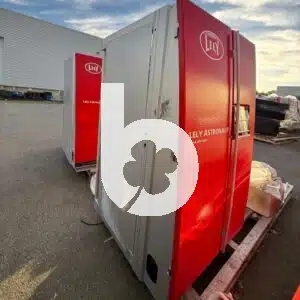
The most widely available brand in Europe and often the one that gives buyers the most peace of mind. Lely robots are known for their reliability, ease of use, and the comfort they provide to cows. The downside is that they’re also the most expensive on the used market, as they retain a high resale value. A safe choice, provided you carefully compare the price with the machine’s condition and history. See our used Lely equipment
A premium brand, renowned for the quality of its milking technology and the robustness of its herd management software. Its used robots typically depreciate more than Lely’s, which often makes them one of the best values on the market. They may require a bit more technical know-how to operate, but they’re ideal for farmers who like to manage their herds based on data. View our used DeLaval equipment
A leading specialist in milking systems, offering compact and technically advanced milking robots that are particularly well-suited for multi-robot setups. Depending on the region, the network of installers and technicians is less extensive than that of Lely or DeLaval, which affects their resale value. As a result, on the used market, GEA often offers recent machines at significantly lower prices—true bargains. See our used GEA equipment
A brand with a smaller presence in Europe, known for its dual-stall robots: a single system that can milk twice as many cows. A cost-effective solution for large herds, requiring a lower initial investment than two separate robots. As with GEA, be sure to check if there’s a brand technician near you. See our used BouMatic equipment
Choosing the right robot depends first and foremost on your farm, not just on the model year listed on the machine. Before buying, we recommend that you check:
Lely A5, DeLaval V300, or GEA R9500? Check out our comparison of used milking robots and our dealer’s review of each model.
A new milking robot often costs between €120,000 and €180,000 per stall, not including installation costs. A recent-model used milking robot sells for an average of around €50,000—up to three or four times less—for technology that is very similar.
At Lely, DeLaval, and GEA, the robots released since 2019 are based on technology that is still widely used in current new models. A well-maintained robot from this generation offers performance close to that of a new unit, and its software can often be updated.
On a recent robot from a major brand, a breakdown can usually be fixed with parts costing a few thousand euros. This is nothing compared to a used tractor, where engine failure can cost tens of thousands of euros. Even a complete overhaul is relatively inexpensive compared to the price of a new robot.
In France, subsidies for the modernization of livestock farms (PCAE and regional programs) generally fund new equipment only. However, they cover only a portion of the investment, are awarded subject to available funding, and involve processing times. With such a significant price difference, a used robot that isn’t subsidized is often more cost-effective than a new, subsidized robot. Work out the numbers with your advisor before making a decision.
A milking robot is easy to disassemble, transport, and set up again. Robots from major brands remain in high demand on the used market: if your plans change, you can resell your robot.
Giving a milking robot a second life also means avoiding the production of a new machine and making use of equipment that is still in good working order—equipment that often comes from an early replacement at another dairy farm. It’s a small victory for the environment.
